

Blog
The Science of Triple Agonists: How Retatrutide Differs from Semaglutide and Tirzepatide

Educational & Laboratory Research Disclaimer: The information provided in this article is strictly for educational, scientific, and in-vitro laboratory research purposes. Retatrutide is an investigational compound and is not approved by the Therapeutic Goods Administration (TGA) or any global regulatory body for human consumption, clinical treatment, or therapeutic use. It must not be administered to humans or animals under any circumstances.
The study of incretin mimetic peptides has evolved rapidly over the past decade. What began with single-receptor agonists designed primarily for glycemic control has progressed into multi-receptor agonism capable of modulating multi-pathway metabolic systems.
For researchers examining semaglutide vs Retatrutide Australia or benchmarking next-generation compounds against dual agonists like Tirzepatide, understanding the exact receptor binding kinetics and downstream pathway crosstalk is critical.
This scientific overview breaks down the receptor architecture, pharmacokinetics, and differential mechanisms that distinguish a triple receptor agonist peptide like Retatrutide (LY3437943) from its single- and dual-acting predecessors.
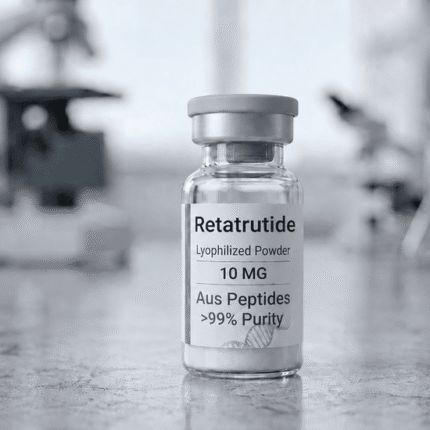
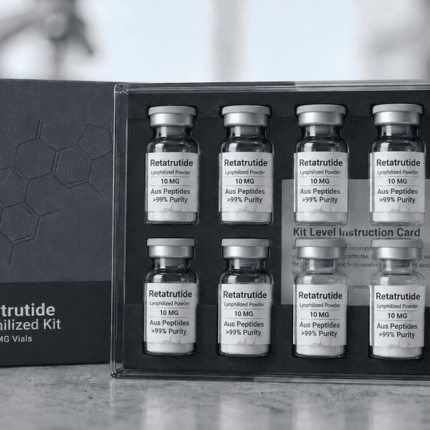
Retatrutide
1. Single vs. Dual vs. Triple Receptor Agonism
To understand how Retatrutide alters metabolic signaling in laboratory models, it is essential to map the evolution of incretin and glucagon receptor target profiles.
Semaglutide (Single Agonist)   --->  [GLP-1R]
Tirzepatide (Dual Agonist)     --->  [GLP-1R] + [GIPR]
Retatrutide (Triple Agonist)   --->  [GLP-1R] + [GIPR] + [GCGR]
Semaglutide: Single GLP-1 Agonism
Semaglutide acts exclusively as a selective GLP-1 receptor agonist. By binding central and peripheral GLP-1 receptors, it slows gastric emptying, stimulates glucose-dependent insulin secretion, and signals satiety through neural circuits in the hypothalamus. However, its mechanism targets energy intake alone, with negligible direct impact on basal energy expenditure.
Tirzepatide: Dual GLP-1 / GIP Agonism
Tirzepatide introduced dual agonism by engaging both GLP-1 and Glucose-dependent Insulinotropic Polypeptide (GIP) receptors. GIP receptor activation acts synergistically with GLP-1 to enhance insulin sensitivity, optimize lipid storage pathways in adipocytes, and improve overall GI tolerability at higher signaling thresholds.
Retatrutide: Triple GLP-1 / GIP / Glucagon Agonism
Retatrutide extends the dual-agonist architecture by incorporating Glucagon Receptor (GCGR) agonism alongside GLP-1R and GIPR. This third vector introduces a distinct metabolic axis: while GLP-1 and GIP work together to suppress caloric intake and regulate glucose, glucagon receptor activation stimulates thermogenesis, enhances hepatic lipid oxidation, and increases energy expenditure.
2. Receptor Binding Kinetics & Structural Design
Retatrutide is a synthetic 39-amino acid peptide engineered from a modified GIP backbone. Its primary molecular structure is conjugated to a C20 fatty di-acid moiety via a linker at Lys30, enabling reversible binding to plasma albumin and providing a extended half-life of approximately 6 days, supporting once-weekly dosing protocols in non-clinical models.
Relative Potency Matrix
When evaluating relative potency in in-vitro functional assays compared to human endogenous ligands, Retatrutide exhibits balanced, custom-tuned binding activity across all three target receptors:
| Receptor Target | Retatrutide Relative Potency (vs. Human Native Ligand) | Primary Downstream Cellular Effect |
| GIP Receptor (GIPR) | ~8.9x Higher Potency | Potentiates glucose-dependent insulin response, enhances adipocyte lipid clearance. |
| GLP-1 Receptor (GLP-1R) | ~2.5x Lower Potency | Slows gastric transit, suppresses appetite via central neural activation. |
| Glucagon Receptor (GCGR) | ~2.9x Lower Potency | Promotes hepatic fatty acid beta-oxidation, drives thermogenesis and basal energy output. |
Note: The reduced potency at GLP-1R and GCGR is intentional—it prevents excessive gastrointestinal distress or unbuffered hepatic glucose output while allowing high-potency GIP action to drive metabolic synergy.
3. The Dual-Axis Mechanism: Energy Intake vs. Energy Expenditure
The defining characteristic of a triple receptor agonist peptide is its ability to simultaneously modulate both sides of the energy balance equation.
                     ┌──> GLP-1R (Appetite Suppression & Slowed Transit)
                     │
RETATRUTIDE ─────────┼──> GIPR   (Insulin Sensitivity & Lipid Homeostasis)  ==> REDUCED ENERGY INTAKE
                     │
                     └──> GCGR   (Lipolysis & Hepatic Fat Oxidation)       ==> INCREASED ENERGY EXPENDITURE
The Glucagon Paradox Solved
Under physiological conditions, native glucagon acts to elevate blood glucose by stimulating hepatic glycogenolysis and gluconeogenesis. In a single-target setting, glucagon administration would carry a glycemic penalty.
However, in Retatrutide’s multi-agonist system:
-
GLP-1 and GIP co-activation stimulates insulin secretion in a glucose-dependent manner, neutralizing potential hyper-glycemic spikes caused by GCGR activation.
-
GCGR signaling activates metabolic pathways in liver tissue, directly accelerating mitochondrial beta-oxidation and reducing intrahepatic triglyceride accumulation without compromising glycemic control.
This mechanism creates a dual metabolic lever: suppressed caloric intake (via GLP-1/GIP) combined with elevated basal energy output (via Glucagon).
4. Benchmarking the Three Generations
For comparative research design, the operational and mechanistic parameters of Semaglutide, Tirzepatide, and Retatrutide are summarized below:
| Property / Feature | Semaglutide (1st Gen Incretin) | Tirzepatide (2nd Gen Dual) | Retatrutide (3rd Gen Triple) |
| Receptor Targets | GLP-1R | GLP-1R + GIPR | GLP-1R + GIPR + GCGR |
| Peptide Backbone | Modified GLP-1 (31 aa) | Modified GIP (39 aa) | Modified GIP (39 aa) |
| Fatty Acid Conjugation | C18 di-acid | C20 di-acid | C20 di-acid |
| Primary Energy Lever | Intake Reduction Only | Intake Reduction + Lipid Storage | Intake Reduction + Energy Expenditure |
| Hepatic Fat Clearance | Secondary to weight loss | Enhanced via GIP/GLP-1 | Direct stimulation via GCGR |
| Regulated Status | ARTG / FDA Approved | ARTG / FDA Approved | Unapproved / Investigational |
