
Blog
A Researcher’s Guide to Retatrutide: Storage, Reconstitution, and Handling Protocols

Educational & Laboratory Research Disclaimer: The information provided in this guide is strictly for educational, scientific, and in-vitro laboratory research purposes. Retatrutide is an investigational triple agonist peptide undergoing evaluation and is not approved by the Therapeutic Goods Administration (TGA) or any global regulatory body for human consumption, clinical treatment, or therapeutic use. It must not be administered to humans or animals under any circumstances.
In vitro research involving multi-receptor agonists demands rigorous analytical protocols. Retatrutide Australia (LY3437943), a synthetic 39-amino-acid triple agonist targeting GLP-1, GIP, and Glucagon receptors, requires precise handling to preserve sequence integrity and biological potency throughout experimental procedures.
Because peptide structural integrity can be compromised by temperature variations, shear force, pH shifts, or contamination, adherence to validated laboratory storage and reconstitution standards is essential.
This technical guide outlines best practices for storing lyophilized Retatrutide, calculating reconstitution volumes using bacteriostatic water, and managing short- and long-term solution stability in laboratory settings.
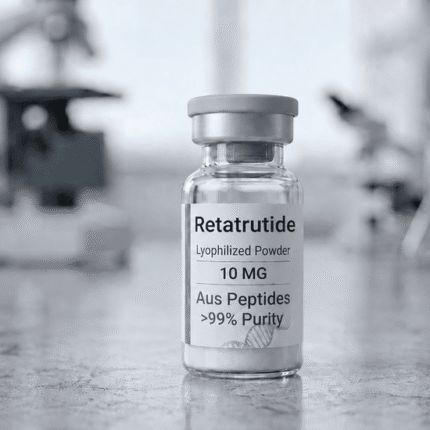
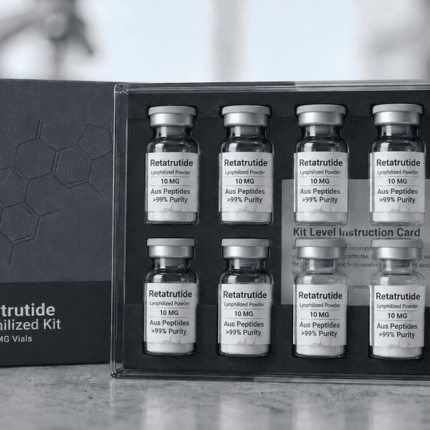
Retatrutide
Retatrutide Australia — 10mg Research Peptide Looking to source high-purity Retatrutide Australia researchers can rely on? Retatrutide 10mg is a
Select options
This product has multiple variants. The options may be chosen on the product page
1. Temperature Control and Storage Protocols
Peptides are susceptible to chemical degradation—including deamidation, oxidation, and hydrolysis—when exposed to unfavorable environmental conditions. Storage parameters depend on whether the compound is in its freeze-dried (lyophilized) state or suspended in aqueous solution.
Lyophilized Powder Storage
Lyophilized Retatrutide is stabilized via freeze-drying, which minimizes ambient water content and retards baseline molecular degradation pathways:
-
Long-Term Storage (-20°C to -80°C): For long-term preservation (months to years), lyophilized vials should be maintained in a deep freezer at -20°C or lower. At these temperatures, degradation is significantly slowed, preserving baseline assay integrity.
-
Short-Term Storage (2°C to 8°C): Unreconstituted vials kept at 2°C to 8°C maintain stability for shorter windows (typically several weeks to a few months). However, long-term deep freezing remains the gold standard for maintaining batch-to-batch analytical control.
-
Desiccated Environment: Vials must be stored in airtight containers with desiccant packs to protect the cake from humidity and condensation.
Reconstituted Solution Storage
Once a solvent is introduced into the peptide vial, the molecule becomes significantly more susceptible to enzymatic degradation, thermal breakdown, and structural aggregation:
-
Refrigeration (2°C to 8°C): Reconstituted Retatrutide solutions must be stored continuously under standard lab refrigeration (2°C to 8°C). Under controlled conditions using bacteriostatic water, solutions typically maintain structural integrity for up to 28 days.
-
Avoid Freeze-Thaw Cycles: Reconstituted liquid solutions should not undergo repeated freeze-thaw cycles. Freezing liquid peptide solutions causes ice crystal formation that cleaves delicate secondary and tertiary peptide structures, degrading target receptor binding capacity.
2. Reconstitution Protocols Using Bacteriostatic Water
Reconstitution is the procedure of dissolving lyophilized peptide powder into a sterile liquid vehicle to prepare liquid samples for laboratory analytical assays.
Selection of Reconstitution Solvent
-
Bacteriostatic Water (0.9% Benzyl Alcohol): The industry-standard solvent for multi-dose laboratory research. The inclusion of 0.9% benzyl alcohol acts as a preservative that inhibits bacterial proliferation over multi-use sampling protocols.
-
Sterile Water for Injection (Preservative-Free): Suitable only for single-use, immediate benchtop assays. Solutions reconstituted without a preservative must be used or discarded immediately to prevent contamination.
Step-by-Step Reconstitution Procedure
-
Equilibrate Vial Temperature: Remove the lyophilized Retatrutide vial from deep storage (-20°C) and allow it to sit at room temperature for 15–20 minutes before reconstitution. Puncturing a cold vial opens it to ambient atmospheric condensation, introducing excess moisture that accelerates peptide degradation.
-
Sanitize Access Surfaces: Clean the rubber stoppers of both the bacteriostatic water and Retatrutide vials thoroughly using 70% isopropyl alcohol swabs.
-
Equalize Pressure & Introduce Solvent: Using a sterile, single-use syringe, draw the calculated volume of bacteriostatic water. Insert the needle into the Retatrutide vial at a 45-degree angle, directing the stream against the inside glass wall rather than spraying directly onto the freeze-dried cake.
-
Dissolution Mechanics: Allow the solvent to absorb into the peptide cake. Gently roll or swirl the vial between your palms until fully dissolved. Never shake the vial. Mechanical shear forces from shaking can denature fragile peptide bonds, resulting in aggregation and loss of function.
3. Laboratory Reconstitution & Dosage Calculations
Accurate dilution math ensures consistent sample concentrations across laboratory trials. Standard laboratory syringes (such as standard U-100 graduated tools) operate on a 100 units = 1.0 mL volumetric conversion.
Basic Dilution Formulas
To determine working solution concentrations and target sample draw volumes, apply these three fundamental equations:
-
1. Concentration Formula: Concentration (mg/mL) = Total Peptide Mass (mg) ÷ Volume of Diluent Added (mL)
-
2. Required Draw Volume Formula: Volume to Draw (mL) = Target Research Amount (mg) ÷ Concentration (mg/mL)
-
3. Syringe Conversion (U-100 Standard): Syringe Units = Volume to Draw (mL) × 100
Practical Laboratory Calculation Examples
Scenario A: Standard 10 mg Retatrutide Vial + 2.0 mL Bacteriostatic Water
-
Vial Mass: 10 mg
-
Diluent Volume: 2.0 mL
-
Target Sample Concentration: 10 mg ÷ 2.0 mL = 5.0 mg/mL
-
Target Dose: 1.0 mg
-
Calculation: 1.0 mg ÷ 5.0 mg/mL = 0.20 mL
-
Syringe Draw: 0.20 mL × 100 = 20 Syringe Units
Scenario B: High-Dilution 10 mg Retatrutide Vial + 4.0 mL Bacteriostatic Water
-
Vial Mass: 10 mg
-
Diluent Volume: 4.0 mL
-
Target Sample Concentration: 10 mg ÷ 4.0 mL = 2.5 mg/mL
-
Target Dose: 0.5 mg
-
Calculation: 0.5 mg ÷ 2.5 mg/mL = 0.20 mL
-
Syringe Draw: 0.20 mL × 100 = 20 Syringe Units
4. Summary of Laboratory Handling Best Practices
To maintain assay reproducibility and preserve batch stability throughout trial workflows, adhere to the following operational parameters:
| Workflow Phase | Recommended Laboratory Protocol | Critical Warning / Risk |
| Lyophilized Storage | Deep freeze at -20°C to -80°C in airtight containers with desiccant. | Avoid exposure to ambient moisture and elevated temperatures. |
| Reconstitution | Direct solvent against glass vial wall; gently roll to mix. | Do not shake. Shear stress causes structural denaturing. |
| Diluent Selection | Use 0.9% Benzyl Alcohol Bacteriostatic Water for multi-use preservation. | Avoid unpreserved sterile water for long-term multi-sampling assays. |
| Reconstituted Storage | Keep refrigerated at 2°C to 8°C; use within 28 days. | Do not freeze liquid solutions. Freeze-thaw cycles break peptide chains. |
Sourcing Laboratory Reference & Reconstitution Supplies
To ensure precision and sterility in laboratory protocols, maintaining reliable supplies is critical.
Researchers sourcing high-purity analytical standards, How to reconstitute retatrutide or reconstitution accessories including bacteriostatic water, and specialized laboratory preparation materials can explore technical documentation, analytical standards, and reconstitution starter supply bundles directly in our catalog: https://auspeptides.shop/retatrutide-tga-status-australia/
Newer
Decoding Certificates of Analysis (COA): Why Third-Party Testing Matters for Research Peptides
Related Posts
Ordering Research Peptides in Australia & New Zealand: Express Shipping & Delivery Times

Educational & Laboratory Research Disclaimer: The information provided in this article...
Retatrutide Vial Sizes Explained: Choosing Between 5mg, 10mg, 20mg, 30mg, and 60mg
Educational & Laboratory Research Disclaimer: The information provided in this guide i...
Decoding Certificates of Analysis (COA): Why Third-Party Testing Matters for Research Peptides
Educational & Laboratory Research Disclaimer: The information provided in this guide i...
Understanding Phase 3 Clinical Trials: What the Data Says About Retatrutide
Educational & Laboratory Research Disclaimer: The information provided in this articl...
The Science of Triple Agonists: How Retatrutide Differs from Semaglutide and Tirzepatide
Educational & Laboratory Research Disclaimer: The information provided in this article...
Retatrutide Status in Australia: TGA Regulations, Scheduling, and Availability Explained
Educational & Laboratory Research Disclaimer: The information provided in this...
Retatrutide in Australia: Is It Legal, and Can You Actually Get It?
If you've been searching for Retatrutide in Australia, you're not alone. Interest has surg...