

Blog
Health News (Weight Loss Medications), Peptides, Retatrutide, Retatrutide Australia, Weight loss Australia
Retatrutide Vial Sizes Explained: Choosing Between 5mg, 10mg, 20mg, 30mg, and 60mg

Educational & Laboratory Research Disclaimer: The information provided in this guide is strictly for educational, scientific, and in-vitro laboratory research purposes. Retatrutide is an investigational compound undergoing clinical evaluation and is not approved by the Therapeutic Goods Administration (TGA) or any global regulatory body for human consumption, clinical treatment, or therapeutic use. It must not be administered to humans or animals under any circumstances.
Designing efficient in-vitro study protocols requires careful consideration of active mass quantities, reconstitution volumes, and batch preservation. When researchers evaluate synthetic multi-receptor agonists like Retatrutide Australia (LY3437943), selecting the appropriate vial mass plays a crucial role in maintaining experimental consistency and optimizing laboratory budgets.
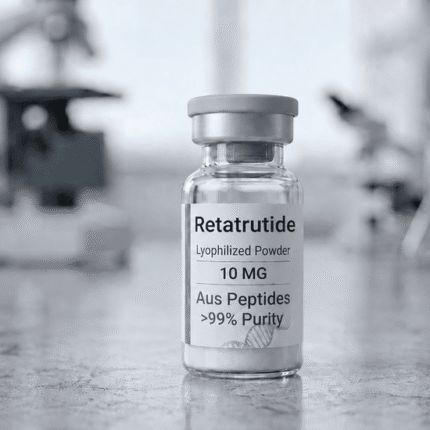
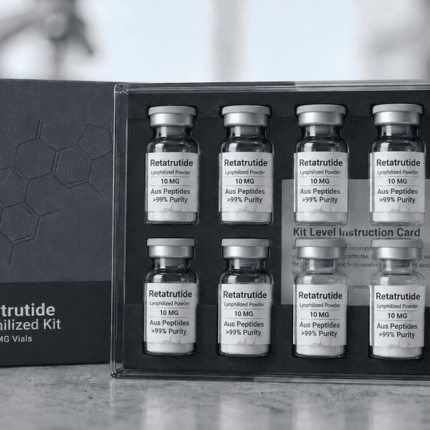
Retatrutide
Retatrutide Australia — 10mg Research Peptide Looking to source high-purity Retatrutide Australia researchers can rely on? Retatrutide 10mg is a
Select options
This product has multiple variants. The options may be chosen on the product page
Because reconstituted peptides have a finite shelf life once dissolved in bacteriostatic water, choosing between smaller vials (5mg, 10mg) and bulk research sizes (20mg, 30mg, 60mg) depends heavily on study duration, assay throughput, and storage logistics.
This technical guide compares standard Retatrutide vial configurations, analyzes cost-per-milligram efficiency, and outlines batch planning strategies for long-term laboratory trials.
1. Breakdown of Standard Retatrutide Mass Options
Selecting the right vial size balances immediate experimental requirements against long-term storage stability.
5mg & 10mg Vials: Short-Term & Pilot Testing
-
Ideal Application: Single-run assays, preliminary range-finding studies, or low-throughput cell culture experiments.
-
Key Advantage: Minimizes liquid degradation risk. Because smaller masses require lower reconstituting volumes, solutions are consumed rapidly within the 28-day stability window for reconstituted peptides.
-
Consideration: Higher cost-per-milligram compared to bulk packaging due to individual vial manufacturing, capping, and lyophilization cycles.
20mg & 30mg Vials: Mid-Tier Assay Programs
-
Ideal Application: Multi-week parallel trials, medium-scale comparative assays, and established research models.
-
Key Advantage: Strikes an optimal balance between unit price efficiency and liquid stability. Allows researchers to maintain consistent working concentrations without frequent re-mixing.
-
Consideration: Requires precise volumetric calculations to ensure accurate concentration tracking across multi-sampling protocols.
60mg Vials: High-Throughput & Bulk Protocols
-
Ideal Application: High-volume longitudinal studies, continuous multi-sample screening, and institutional lab allocations.
-
Key Advantage: Delivers the lowest cost-per-milligram, significantly reducing long-term laboratory expenditure.
-
Consideration: Reconstituted liquid bulk must be stored under strict temperature controls (2°C to 8°C) and processed efficiently to avoid potencies diminishing before total consumption.
2. Cost-per-Milligram Efficiency and Budget Optimization
For institutional research labs, unit economics directly influence project longevity. Freeze-drying and third-party quality testing (such as HPLC and Mass Spectrometry) carry fixed per-vial overhead costs regardless of the mass contained inside.
+-----------------------------------------------------------------------+
|  VIAL MASS vs. COST EFFICIENCY TRAJECTORY                             |
|                                                                       |
|  5mg  | [$$$$$$$$$$$$$$$$$$$$]  Highest Cost Per Milligram            |
|  10mg | [$$$$$$$$$$$$$$$$]                                            |
|  20mg | [$$$$$$$$$$$$]                                                |
|  30mg | [$$$$$$$$]                                                    |
|  60mg | [$$$$]                  Lowest Cost Per Milligram (Bulk Value)|
+-----------------------------------------------------------------------+
Key Economic Drivers:
-
Fixed Analytical Costs: Every production batch requires independent third-party verification. Spreading testing fees across larger unit masses (e.g., a 60mg peptide vial) significantly lowers the unit price per active milligram.
-
Packaging Overhead: Vial glass, stopper materials, crimps, and labeling contribute to baseline production costs. Larger mass allocations maximize chemical yield per package unit.
-
Consumable Savings: Utilizing larger mass units reduces overall consumption of diluents, sterile syringes, and storage real estate over long-term research cycles.
3. Batch Planning & Stability Guidelines
To ensure batch integrity remains stable across experimental timelines, apply these protocol guidelines based on your selected vial configuration:
| Vial Configuration | Reconstitution Strategy | Target Protocol Duration | Primary Risk / Warning |
| 5mg / 10mg Mass | Reconstitute with 1.0–2.0 mL BAC Water | 1 to 14 Days | Frequent batch re-mixing required for ongoing trials. |
| 20mg / 30mg Mass | Reconstitute with 2.0–3.0 mL BAC Water | 14 to 28 Days | Solution must remain continuously refrigerated at 2°C to 8°C. |
| 60mg Mass | Reconstitute with 3.0–5.0 mL BAC Water | High-Volume / Multi-Sample | Do not freeze reconstituted liquid; plan usage to avoid waste. |
Pro-Tip for Long-Term Storage:
If your lab orders high-mass quantities for long-term project planning, keep all un-reconstituted vials in deep freezer storage (-20°C to -80°C). Freeze-dried lyophilized powder remains stable for extended periods at sub-zero temperatures, allowing you to reconstitute individual vials only when active benchtop testing begins.
Sourcing Laboratory Reference Standards
When selecting active material quantities for laboratory assays, ensuring verified purity and accurate fill weight is essential for reliable data collection.
Researchers evaluating target masses, technical specifications, and laboratory pricing across variant options can inspect verified documentation and order buy retatrutide 10mg, retatrutide 20mg, retatrutide 30mg, or bulk 60mg peptide vial options directly in our catalog: https://auspeptides.shop/product/retatrutide/
Related Posts
Ordering Research Peptides in Australia & New Zealand: Express Shipping & Delivery Times

Educational & Laboratory Research Disclaimer: The information provided in this article...
Decoding Certificates of Analysis (COA): Why Third-Party Testing Matters for Research Peptides
Educational & Laboratory Research Disclaimer: The information provided in this guide i...
A Researcher’s Guide to Retatrutide: Storage, Reconstitution, and Handling Protocols
Educational & Laboratory Research Disclaimer: The information provided in this guide i...
Understanding Phase 3 Clinical Trials: What the Data Says About Retatrutide
Educational & Laboratory Research Disclaimer: The information provided in this articl...
The Science of Triple Agonists: How Retatrutide Differs from Semaglutide and Tirzepatide
Educational & Laboratory Research Disclaimer: The information provided in this article...
Retatrutide Status in Australia: TGA Regulations, Scheduling, and Availability Explained
Educational & Laboratory Research Disclaimer: The information provided in this...
Retatrutide in Australia: Is It Legal, and Can You Actually Get It?
If you've been searching for Retatrutide in Australia, you're not alone. Interest has surg...